Hands That Hold

Photo via case.edu

I saw a familiar sight as I walked out of the grocery store.  A dad and his daughter, no more than three years old, simply talking while walking to their car with groceries in hand. However, just as I glanced over, she began to pitch a monumental fit!  Arms flailing, crying, screaming-she threw herself on the ground.

My very first thought was, Boy am I glad my kids are past that stage!  Ha!

I was curious as to how the dad would respond.  With a bag of groceries in his left hand, he reached down with his right arm and picked his daughter up and carried her, barrel-style, all the way to the car.  I was memorized at how calm, cool and collected he was.  He didn’t lash out or yell or anything.  He also knew better than to try to reason with a three year-old in this state. He simply picked her up and walked on with her under his arm as she continued to fuss and flail.

My second thought was, Wow, that dad is amazing!  He didn’t even flinch.  

God spoke to me and said, Look familiar?

Yes, indeed, I snickered.  I remember those days with my kids like it was yesterday.

I’m not talking about your kids.  I’m talking about you, He whispered.

Oh my!  He was right.  There have been times in my life when God needed to intervene for my good even when I disagreed.  No discussion.  No reasoning.  Just action on His part in response to mine.  Whether I am overwhelmed with emotion, or so busy I can’t clearly think things through, God never gets flustered.  He is the same yesterday, today and forever (Hebrews 13:8).

Would it have been okay for that dad to have driven off in frustration and left his toddler in the parking lot?  Would it have been okay to let her have her way and stay lying on the ground in the middle of the road with cars coming and going?  Would he have really had been able to articulate all the reasons why she needed to get up and move to safety?  Not in that moment. This dad acted in her best interest even though she didn’t understand or agree with his response.

I am so thankful that God does the same for us.  He sees the bigger picture and understands situations far better than we do.  When circumstances arise that we fall apart over, God is still on His throne and is able to make decisions based on what’s best for us-even if we’re throwing a fit on the inside.  Even if it means He must proverbially pick us up and remove us from the situation whether we think we know what we want or not and regardless if we think we know what’s best for us at the moment.

His hands are strong.  His heart is loving.  His mind is omnipotent.  Even when we falter and lose our senses, He is still in control.  There is a time for everything.  A time to discipline.  A time to discuss.  And a time to simply act on our behalf.

Below are some photos I’ve taken that remind me of His hands, His wisdom and His love for us. May we be able to walk obediently with God today.  And if not, may He know when we need to be picked up and carried.

The LORD answered Job… and said, “Who shut up the sea behind doors when it burst forth from the womb, when I made the clouds its garment and wrapped it in thick darkness, when I fixed limits for it and set its doors and bars in place, when I said, ‘This far you may come and no farther; here is where your proud waves halt’?  Job 38: 1, 8-11

Look at the birds of the air; they do not sow or reap or store away in barns, and yet your heavenly Father feeds them. Are you not much more valuable than they?  Matthew 6:26

…See how the lilies of the field grow. They do not labor or spin. Yet I tell you that not even Solomon in all his splendor was dressed like one of these. If that is how God clothes the grass of the field, which is here today and tomorrow is thrown into the fire, will he not much more clothe you, O you of little faith?  Matthew 6:28-30

(Creation You have made) all looks to you to give them their food at the proper time.  When you give it to them, they gather it up; when you open your hand, they are satisfied with good things. Psalm 104:27-28

The heavens declare the glory of God; the skies proclaim the work of his hands. Psalm 19:1

<<Check out the companion song to this post on my Tunes page!>>

Respect: Cost versus benefit for parents and children

Yesterday we discussed respect and why children need to learn it.  Today, I want to touch on two main issues that can make or break respect – for children and adults.

Self-control and pride.

These are the muscles that either work for or against respect.  When we take away the drama of disrespect and peek underneath at what motivates someone to be disrespectful, typically there is a lack of self-control and an overload of pride.

Disrespect can be shown in any number of ways.  Anyone can do it.  It’s easy!  We just say what we feel with no filter on our mouths.  Or, we do what we feel like with no thought or concern of the repercussions to our actions.  Disrespect is easy.  It’s also very costly.  Once a word leaves our mouth, we can never ever retract it.  We can say we are sorry a hundred times, but it doesn’t make the word(s) disappear.  Sticks and stones – yeah, right.  We all know words hurt.  It’s why we use them against people-to hurt them.  Whoever first coined this phrase was spot on: If you can’t say something nice, don’t say anything at all.  If everyone lived according to that the world would be a better place.

Disrespect can be shown in many ways without ever physically touching the other person.  Deliberate defiance, foot stomping, walking away, eyes rolling and rude body language screams disrespect without uttering a word or producing physical harm.  Oh, we are good.  We know exactly how to show disrespect if we want to.  After all, it comes naturally!  And for those who are closest to us, we know precisely the hottest buttons to push to show it.

When parents let a word from a child go here and there, they are in essence telling them what is acceptable behavior.  If the child says something out of line either by way of subject matter or foul language, and the parent turns a blind eye to disrespectful behavior, they have just told the child it is perfectly okay to say or do it.  A non-response is a response nonetheless.

Parents can, and should, only deal with so much at time.  Rome wasn’t built in a day, and if heavy subject matter is being addressed, it is ineffective to try to correct every single thing the child has done wrong right then and there.  But, it must be addressed at some point.  After conflict, parents just want peace and quiet in their homes, so who wants to dredge up more issues?  However, if the issue isn’t addressed, rest assured it will come up again and again.  And, every time it comes up, a precedent has been set that whatever the child has said or done is permissible.

Children remember.  They remember it was okay to say it, or do it, last time and they are thinking, So who’s the hypocrite now?  I could get away with it before and not this time?  Who’s the double standard now?

They are right.  One thing I often tell my tween and teens regarding peer pressure is this – you have to have already made up your mind how you will respond to a situation.  It’s far too much pressure to try to sort it all out in the heat of the moment.  You have to have already determined your boundaries, that way, when the moment of decision comes you can simply fall back on what you previously decided.

It’s much the same with parenting.  We have to have a plan.  We must have boundaries.  We must gather the courage to stick to them.  Waiting until something comes up in the middle of conflict to determine how you feel about it is not the time to debate within ourselves what we should do.  We should already know what we’re are going to do.  It takes a lot of pressure off of ourselves to simply follow through with our standard, rather than create one on the spot.

Additionally, standards created on the spot are not reliable.  Factors that affect said standard are: the offense committed by the child/teen, how angry the parent is, how volatile the conflict gets, the kind of day the parent has had (what Mom or Dad’s mood is going into the conflict), and likewise what kind of mood and day the child/teen has had.  All of those are centered around emotions, and emotions are fleeting and are extremely temperamental (pardon the pun).

Decisions about what a parent will allow the child/teen to say must be predetermined when there is no conflict and the parent is in control of himself or herself.  It is so much easier to parent with a plan, rather than make it up as we go.

(Tip – kids see right through a spontaneous plan, and they know how to use it against us.  I think they can smell it or see it or feel its vibe (just kidding), but they know us well enough to tell the difference when we are readily prepared and when we are winging it.)

Disrespect is a lack of self-control.  We just can’t help ourselves!  We know we are right, or even when we know we are wrong – we’re gonna be heard – and whatever it takes to make us feel heard, well, so be it.  Yikes.  This philosophy will land the growing child grounded and the adult child unemployed and most likely alone.

Self-control and pride.  When I think about these two character traits, I see with my mind’s eye, the silly image we’ve all seen before.  A person standing with a little angel that looks like the person on one shoulder and a little devil that looks like the person on the other shoulder.  They are both debating their point-of-view into the person’s ear.

Self-control is one of the hardest virtues!  A lack of it wages war against our better judgement, only sees the moment, and could care less about long-term effects of the situation.

Pride is truly the root, the seed, of a lack of self-control – which leads to disrespect.  We don’t want to admit we are wrong, and we certainly don’t want anyone to tell us we are wrong!  A heaping dose of pride inhibits us from letting the other person finish speaking, choosing not to slam the door, choosing not to jump in the car and drive off, choosing not to say something we will deeply regret later.

For children of all ages, they are trying to figure this all out.  They do not have the life experience of say, getting fired from a job for yelling at the boss, or having security come remove them from the classroom for refusing to participate.

They are in a season of life of testing boundaries.  It’s not necessarily always about how “bad” they are behaving.  Sometimes, whether they realize it or not, they are trying to find civilized boundaries.  When parents don’t teach them boundaries, how do kids know when to stop?  If parents don’t have a plan, and therefore are constantly moving the boundary lines, then unnecessary confusion is created and no one is going to come out of that successfully.

There once was a study done with a group of children.  They placed the children in a fenced-in yard with tons of fun things to do: swings, toys, slides, you know, fun stuff.  The kids had a blast!  They were as busy as ants at a picnic.  Then, they took the fence away, but left the toys.  The same group of kids meandered aimlessly around as if they were lost.  They didn’t play with the toys.  They just…wandered around.  Fascinating!  The conclusion was that when the fence was there, the kids knew they were free to do everything inside the fence.  When the fence was removed, the kids didn’t know what they could do because they didn’t know how far they could roam or what else around them was fair game to play with.

The same principle applies to parenting in regards to respect.  Parents must show children what is acceptable and what is not.  They must use the same fence every time.  Don’t move the fence around – that won’t help and will only confuse the child.

Is the child allowed to cuss at the parent?  Yes or no.  Is the child allowed to yell at the parent?  Yes or no. Is the child allowed to tell the parent to shut-up?  Yes or no.

Is the child allowed to storm off in an argument?  Yes or no.  Is the child allowed to slam doors, throw objects or turn away from the parent when being spoken to?  Yes or no.  Is the child allowed to roll their eyes or show other similar body language?  Yes or no.

These are the kinds of boundaries that need to be predetermined – preferably before the child is born, but it’s never too late to begin healthy, CONSISTENT boundaries.

Here’s a tough word…any of the above mentioned that the child/teen is permitted to do to parents, he or she will do the same things to their future boss and spouse.  How’s that going to work for them?  It won’t end well.  And, for parents who are still trying to be their child’s best friend in the growing years, allowing the child/teen to get away with these things through rationalizing or justifying in the parent’s mind (oh, they’ve had a bad day, they’ve had a hard life, etc.) is going to result in the child resenting the parent.  Why? Because the parent, in either spoken or unspoken terms, told the child it was okay to behave like this, but when the grown child tries to pull this stuff on the world, he or she will quickly find out the hard way the world won’t tolerate it and there is a price to be paid for such behavior.  The grown child will, in essence, be baffled as to why the parent didn’t warn them.  Why did the parent lead them on in something that is not reality?  Why didn’t the parent better prepare the child for the real world?  What will the parent say then?

Self-control, pride and respect are a threesome that cannot be separated.  A parent cannot deal with one without knowing the other two are in cahoots with it.  Again, a moment of conflict is probably not the best time to address every single last issue.  The child is not in a position to hear and process all that at once.  But, when tempers have cooled down and everyone is thinking clearly and in a receptive mood to listen, boundaries must be reaffirmed and appropriate consequences given for breaking through the fence.

We are not born knowing boundaries.  We are born trying to buck them.  Take advantage of the little amount of time we have to set up our children for a successful future.  It may mean rough waters for now, but the end result is a healthy family who knows their rules and children know their place.  The end result will, hopefully, be mature, respectful children who will esteem their parent for better preparing them for the real world.

Bottom line – a parent will count the cost for how they parent now or later.  The parent must choose whether to work through the rough spots now, even though they are tired, have hard jobs, have hard marriages, or feel too inadequate to effectively parent, or the parent can choose to turn a blind eye, remove the fence for the sake of a moment of peace and not invest in a plan, but wind up with a grown child who has trouble with work and relationships – including with the parent.

We must decide today – today – how we will parent.  There are many great books about parenting available.  Invest now and enjoy the payoff later.

<<Check out a great book recommendation on my Books page!>>

What’s the big deal about teaching children respect?

Exodus 20:12, Honor your father and your mother…

Scenario #1 – As I sat on the football field this weekend watching my youngest’s team play football, I noticed an interaction between another mother and son.  It was something I’ve seen happen many times.  Too many.

It’s halftime, and Mom notices her tween son might be thirsty, so she jumps up and begins walking toward her son with a bottle of Gatorade.  He meets her more than halfway and, in front of all of the other parents of both teams, he chastises her to stay off of the field.  She quickly submits to his request and retreats off of the field with subservient speed.

As she holds out the Gatorade and tells him she thought he might be thirsty, he snaps, Where’s my water.  I wanted water.

Oh, your dad is supposed to bring that but he isn’t here yet, she says smiling.

I wanted water, he demands.

Okay.  I’m sure he’ll be here soon.  Would you like some Gatorade for now? she asks, looking longingly at him.

Pfft, he said with obvious disapproval.  He snatched the bottle out of her hand and walked away.

Have fun! she called to him as she sheepishly smiled at the parents sitting nearby and took her seat.

I wanted to say to him, Go thank you mother.  You never said, please, or thanks for the Gatorade, or I appreciate it.  Nothing.  Zippo.  It was the same attitude of entitlement and disrespect that is so common no one bats an eye anymore.

Whose fault is it?  Parent or child?  My opinion is that it’s both – at least at this age.  What happened to a society where children honored their fathers and mothers?  Where bare-bones politeness was common courtesy.  Where parents received respect for the little and big things they did for their children.

Okay.  Pause.  I am not addressing abusive or neglectful parents. I am not talking about dysfunctional homes (though many are in some manner) or anything that needs professional help.  I’m talking about every day moments in life when who the person really is on the inside shows on the outside.

Scenario #2 – I was at the dentist office waiting for my child’s checkup to finish.  It’s a very kid-friendly place and has all kinds of things to do to keep little ones entertained while older siblings have their appointment.  A little girl, no older than four, quietly played with the office’s toys.  Mom and Dad watched nearby.  It was time to go back to see the older sibling, and so the dad asked his young daughter to pick up the toys she had taken out.  She just stood there and stared at him.  Then ignored him.  He repeated his request.  This time she said, No.  He asked her a third time, and she simply turned around and walked away with the mom and left Dad and the toys behind.

I was very curious how he would respond and held my breath as he stood there looking at the mess she had made.  I said (to him) to myself, Don’t do it.  Don’t do it.  Then…he did it.  With drooping shoulders, and donning not an ounce of dignity, he began picking up the toys for her.  He picked up every last toy, in front of a full room of women, and then disappeared into the hall to find his family.

My children learned something interesting in school.  In early America, children did not eat with their parents.  Not only that, they were not allowed to talk during dinner.  Not only that, they waited on their parents while the parents ate.  Not only that, the children stood and ate, they didn’t even get a seat when it was their turn.  This was our country once upon a time.

Now for me, that seems extreme.  On the contrary, my family loves our family dinners – something we make a priority in our home.  I’m not suggesting we take away our children’s seats and forbid them to speak, but how in the world did we get from there to here where kids sit at the proverbial head-of-the-table and parents ask their permission to speak?  This blog is far too short to answer that question.  Much research has gone into family roles & dynamics, American history and the changes it’s seen and how that affects the individual.  It’s a black hole of information, unfortunately, because although we clearly see patterns of a downward spiral in our society in regards to respect, manners, and courtesy, few seem to want to do anything about it!

Why do parents allow their children to captain the ship? Rule the roost? What good do they think will come from it?  Oh, I know.  They will gain their child’s respect and friendship.  Um.  Bad news…that philosophy won’t work.  And, shouldn’t it be the other way around?

Why do parents need their children’s approval on their job as a parent?

Who is the leader of the family?

Why are parents afraid to parent?

Why are they afraid of their children? (children who abuse their parents notwithstanding)

When did parents relinquish their power and surrender authority to their children?

How do they think this will ever help the child as an adult?  I have so many questions.

We are all born selfish.  It’s our human nature.  But, unless we are going to live in solitary confinement on a deserted island, we have to act as a society, and family is the cornerstone to any society.  It is the parent’s job to set boundaries and rules for their kids (and follow through on them).  But, kids who are at the age of accountability to accept the appropriate consequences of their behavior must answer for themselves.

When I look at families where the child has the parent wrapped around their little finger at age 7, 9, and 11, I think what fun that house will be when hormones rage in the teen years.  The battles parents and kids have now when they are young, battles where the parents ultimately give in to whatever the topic du jour is, will be more fierce, more intense and create more problems in the teen years than young parents can ever imagine.

Godly authority exercised by the parent, and godly respect given by the children, is how families were divinely designed.  The precious gift of mutual friendship comes later when the children are no longer children and are no longer under the authority of the parents.

Until then, it’s not an even playing field.  Children don’t have equal say, equal voice, in a matter.  It’s not their job because they aren’t qualified for the job as an adult at their ripe, young age.

Some reasons parents cave is because they are either: too tired, too frustrated, too weak, too afraid, have no parenting plan, don’t care, or have become stuck in an unhealthy pattern with their children like a fly stuck to flypaper.

One thing I remind myself of when we address respect in our home is this – how my child treats me now is how they will treat me when I am old.  In other words, how I allow my child to treat me now, is how they are naturally going to relationship with me when I am old and need their help.  It’s something to think about.

Kids who are allowed to say anything, do anything, to their parents will be adults who could care less about their aging parents’ needs.  After all, life is all about them, and that’s the way it’s always been for them…so why is the parent shocked decades later when the grown child shows no concern for them?

I have personally witnessed a boy hit his mother in the head when she said No to something he wanted.  She gave in.  What will happen when he is bigger and stronger than her and she says No again – and maybe means it this time?

The formula is simple: selfish child = selfish adult; demanding child = demanding adult; bossy, disrespectful child = bossy, disrespectful adult.  How will that fair for them in the workplace? In marriage?  In friendships when Mom no longer arranges the play dates?

What I see is parents want to skip the teaching, training, and tough love and jump right to the parent/adult child friendship.  This plan will fail.

Scenario #3 – My friend told me that once she, her kids and her adult sister were in a store in the checkout line.  My friend’s daughter (very young at the time) wanted something from the impulse aisle.  My friend said, No.  Her daughter proceeded to throw the biggest tantrum ever.  Resolving to not give in, my friend looked at her visiting sister and said, Can you handle it?  Her sister replied, Yep.  Well, okay, then, my friend said.  And they stood there ignoring the tantrum that had caught everyone’s attention. They were resolute, and guess what?  The daughter wasn’t permanently scarred!  Actually, she grew a little more as a person that day, and she is a very lovely young lady today.

Perhaps maintaining an image is why parents cave.  What will people think of me if my toddler screams their head off over me not buying this toy they want?  I can tell you what some are thinking, Been there.  Done that.  Stay strong.  I’d much rather see a little child throw an obnoxious fit over not getting a toy, then an obnoxious adult throwing a fit over anything!

If parents are hoping that some shift in respectful maturity will magically happen between childhood and adulthood without intentional training, they will be sorely disappointed.  Maturity eventually happens, most of the time, but that doesn’t guarantee a respectful adult.  Just look at the statistics in our country from crime to divorce to prescription drug use to alcohol abuse and so on.  Look at the television shows that are “supposed” to have a pulse on the heartbeat of America.  I’ve never seen so many disrespectful people on the small screen – from mouthy children on kids shows to R-rated reality adult shows.  Really?  This is a portrait of us?

Parenting, especially parenting in the early years, is like the game Risk.  There must be a strategy.  There must be intentional moves on the parent’s part.  There must be a goal to work towards.  There must be diligent work on the parent’s part.

No one said parenting was easy, and we need to put our big girl panties on and accept it.

Laying a foundation of who’s in charge and how things will role will pay off later.  I remember once on a bad day of behavior in our home, I looked my children in the eye and said, I’ll do the hard thing, every time, because it’s the right thing.  Even if that means Mom needs a time out first.  In the moment, it is extremely easy to take the quick way out and give in to the demands of kids.  It’s so understandable that Mom or Dad has had a long day and they are tired.  I completely empathize with being physically, mentally and emotionally drained.  But, losing small battles leads up to losing the war.  No, we don’t want to be at war with our children, but our carnal natures sure are.  It’s how we are wired.  One will win.  One will lose.  Which will it be?

Even the Apostle Paul, a full-grown adult, couldn’t understand it.  His words are some of the most confusing in the Bible…

Romans 7: 14-21

14 We know that the law is spiritual; but I am unspiritual, sold as a slave to sin. 15 I do not understand what I do. For what I want to do I do not do, but what I hate I do. 16 And if I do what I do not want to do, I agree that the law is good. 17 As it is, it is no longer I myself who do it, but it is sin living in me. 18 I know that nothing good lives in me, that is, in my sinful nature. For I have the desire to do what is good, but I cannot carry it out. 19 For what I do is not the good I want to do; no, the evil I do not want to do—this I keep on doing. 20 Now if I do what I do not want to do, it is no longer I who do it, but it is sin living in me that does it. 21 So I find this law at work: When I want to do good, evil is right there with me.

Whew.  If even he struggled with how to behave and what to do, a former flawless Pharisee and completely committed ambassador for Christ, then how confused must children be, who have much less life experience, to understand about how to live?

I love my children with all my heart.  And because of this, I love them enough to do the hard thing (i.e., calling them out every single time disrespect rears its ugly head – which is rare, by the way, because my husband and I have set the foundation mention above) in order to keep peace in our home and to set them up for success now and as they grow.  Teachers won’t tolerate rude students.  Employers won’t tolerate disrespectful employees.  In this economy there are ten people lined up waiting for that job!  In a marriage – well – just look at the divorce rates.  They speak for themselves.

Allowing disrespect by way of physical or verbal communication stunts children’s emotional growth. Eventually, if parents want their children to be employable and marriable, children have to learn respect – and this begins at home.

Teaching them this truth now will save them much heartache later.  It may also save their marriage, their job and their friendships.  And, it may give parents what they hope for one day – a healthy friendship with their adult child.  In moments of conflict, think long-term goals.  Parenting is not a sprint.  It’s a marathon.  A strong finish is possible.  Don’t give in or give up.  Your children are counting on you to show them the way – even if they don’t act like it or say it.  Run strong. Lead the way.

Torn in two

He has showed you, O man, what is good. And what does the Lord require of you? To act justly and to love mercy and to walk humbly with your God. ~ Micah 6:8

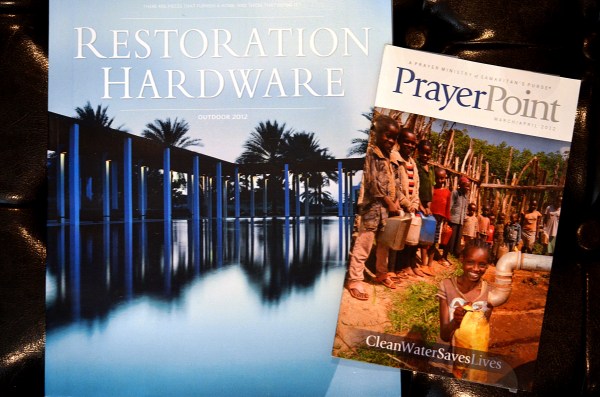
I was picking up the house recently when something stopped me dead in my tracks.  Literally, I took one step forward and froze.  Looking down at our coffee table, I saw some mailers that have sat for over a week.  Each one was complimentary and was delivered to my home – ironically arriving within a day of each other.  When they arrived, I placed them on my coffee table like I do with current mailers and never gave it another thought.

This time, my heart skipped a beat as I gazed, with fresh eyes, at the dichotomy of these things. See for yourself…

Do you see what I see?  Contradiction.  Two worlds clashing.

Both of those reflect me, and I am frustrated!  On one hand, my heart is passionate for all people and want no one to suffer.  I want everyone to know the love of Jesus and have all of their needs met; for everyone to realize their goals and dreams; and for peace and provisions worldwide.

On the other hand, I get stuck in what I know as normal.  I like Restoration Hardware (though I can’t afford most of what they sell).  I like their style, ideas, and clean lines.  It’s not just Restoration Hardware, but this is the mailer that happened to be sent at the same time as PrayerPoint.  I’m not picking on it, but I am confused with where it all stands with me.

I think I’ve spent my life like most people in America.  I have not been blind to the world around me, but honestly, it didn’t directly affect my daily 24/7.  The needs and injustices of this world have always made me want to help, and we do what we can, but within the longitutde and latitude of my life in America, there is a whole different normal.

I’m not saying there is not hardship and suffering here. There is. But, comparatively, we do not live in a war-torn land; we have freedom of speech & religion; we have basic things like paved roads, clean water and electricity;  we have sanitation systems that keep infection and disease down; we have laws (albeit not perfect!) against child labor, for safe working conditions, to monitor sanitation levels in restaurants, hospitals, etc.; truancy laws to keep kids in school; laws against child abuse, parent abuse and spousal abuse; and we have legal rights in the justice system.  Take away the tangible things and America is still, by far, a very rich place in which to live.

Most people in the world have far fewer rights and protections and live on $1 or less per day.  26,000 people, including children, die every day from preventable diseases and illnesses.  The rate of human trafficking, starvation, drought and political conflict is mind-boggling.  Does it affect where my kids go to school?  Where I buy my groceries? Where I go to church? I must admit, for many years I kept the two dichotomies separated.  We help locally and globally, but my daily grind did not know the physical hardships of most people in the world.

In the last few years, however, God has awoken me from a hazy sleep.  He broadened my narrow vision in a whole new way.  With the organizations we volunteer for, God has given us more work and responsibilities.  With our church, God has given us more opportunities to serve.

It’s a whole different story to know orphans that I call by name and pray for every day.  Whose faces are on the walls of my daughter’s bedroom and who are smiling at me every time I close my eyes wondering how they are doing in Kenya.  Children we’ve met, played with and held.  Teens who have dreams and hopes and goals, but little to no help to achieve them.

No one is less important than anyone else, but “here” and “there” have felt light years apart for years.

I’ve always been a huge advocate for water conservation because I grew up in an area where there was a constant threat of drought.  I try to do my part by taking very short showers; turning off the water when brushing my teeth; dumping boiled vegetable water on my outdoor potted plants; watering indoor plants with leftover cups of water; using large shade trees to cool the grass instead of a sprinkler system; and using water-saving car washes (only when truly needed) versus the hose water running down the gutter.  Very little water goes to waste in our house.  Even still, I feel so guilty for using any of it because I saw the miles people walk, barefoot and carrying plastic jugs, to fetch their daily water supply.  The water I wash my dishes with is far cleaner than the only water many people have to drink.

And, we have a house.  It’s not the biggest, it’s not the smallest.  We do, however, use every square inch of it – none of it wasted space.  One could look at the daily messes in it to know that it is true!  But, how many people in the world have a house?  Not many.   Every night when we say prayers with the kids, we thank God for a bed to sleep in and a roof over our heads.  But, we also pray for those who don’t have such luxuries.

That’s my point.  Why do some people call them luxuries and some call it a normal standard of living?  It’s all what we’re used to.

My life has been used to one way of living.  My heart has always known better.  As I experience more of this planet, the gap between the two dichotomies is only growing wider and it’s tearing me in two.

How do I enjoy things like flipping through a Restoration Hardware catalog and dreaming of the what-ifs, while I know children are dying because they don’t have simple vaccines or enough food to survive?

How do I serve those who need help, but still be thankful for what God has blessed me with like a full belly, shoes on my feet, and a home with doors to lock and a van to drive?

I can’t figure this out.  Part of me wants to sell everything and move to a faraway land.  Part of me feels called to stay put and continue the ministries that we do stateside that help people all over the world because of the resources we have here.

The summer before God called our family to short-term mission, we put a pool in the backyard of our home that we’ve lived in for 15 years.  It’s not a huge pool, but it fits the size of our motley crew.  We saved for a very, very long time and made sacrifices in other areas to make it happen.  It has been a great tool to strengthen our family time, and we love to have extended family and friends over to enjoy it with us.   But, the next summer we surprisingly found ourselves in Africa, and this summer we are preparing for another mission to a different part of the world, and my husband and I wonder if we did the right thing with the pool.  We are deeply thankful God allowed us to save the money to do it, but I also now know a lot better now how far that money could go to help people simply survive.  If we had the same choice to make all over again, would we build it?  And is this a contradiction to my water conservation awareness?

Ug.

I may never find a balance within my heart with these two parts of me.  The world itself is not balanced.  It does bother me, however, to not even notice the two vastly different mailers sitting right next to each other on my coffee table as if they were equal reading.  They are not.

One thing I can do is this:

  • Continue to teach my children the difference between need and want (Matthew 6: 25-33)
  • Teach them the value of serving others (Matthew 20:26-28)
  • Teach them to consider others more highly than they consider themselves (Philippians 2:3)
  • Teach them not to be afraid of hard work (2 Thessalonians 3:7-12)
  • Teach them to be grateful for what they have, not to have too much of it, and be willing to share it (Philippians 3:12-13; Acts 2:44-45)
  • Teach them the value of money and its proper place in our lives (1 Timothy 6:6-10)
  • Teach them to tithe (Leviticus 27:30; Matthew 22:21)
  • Teach them to work as unto the Lord and not for the glory of people or ourselves (Ephesians 6:7-8; Colossians 3:23-24)
  • Talk with them about ways they can use their gifts and talents to make a difference in this world (Ephesians 2:10)
  • Talk with them about what lasts in this world – and what doesn’t (Matthew 6:19-21)
  • Talk with them about love and who deserves our whole heart (Deuteronomy 6:5)
  • Encourage them to always look for good to do…and do it (1 Timothy 6:18)
  • Example all of this in my own life first.

Children truly imitate their parents – for better or worse.  If we want to play a role in helping this world survive for generations to come, change needs to begin with us.

Decades ago, my mom clipped a poem by Charles Kingsley and pinned it to our kitchen corkboard.  This little piece of paper is one of the only (and most beloved) treasures I have left from losing everything in catastrophic loss when I was a teen.  Below is a scan of the original.

Every time I try to wrap my head around the dichotomy of my world and the world, I end up with more questions than answers.  Returning from Africa, I feel like I have no home.  Like I told a friend, I’m not comfortable living in this society because we have so much, but I’m not sure I could handle living there with its unrelenting hardships.

I feel like I don’t fit in anywhere.

I think that’s exactly where God wants our hearts.  As Christians, we are citizens of another world.  A world our eyes cannot see, but one our hearts are drawn to.  This isn’t where we belong.  It shouldn’t be comfortable.  Pardon the double negative, but it shouldn’t be a place that we wouldn’t want to leave if the Lord called us home.

John 18:36 – Jesus said, “My kingdom is not of this world. If it were, my servants would fight to prevent my arrest by the Jews. But now my kingdom is from another place.” 

Philippians 3:20-21 –  But our citizenship is in heaven. And we eagerly await a Savior from there, the Lord Jesus Christ, who, by the power that enables him to bring everything under his control, will transform our lowly bodies so that they will be like his glorious body.

1 Peter 2:11 – Dear friends, I urge you, as aliens and strangers in the world, to abstain from sinful desires, which war against your soul.

I can relate as someone who finds herself a nomad at heart, a stranger passing through this life.

God wants us to enjoy His gift of life, to enjoy the tangible and intangible blessings of life, and be thankful for what He has given us (not which was attained by selfish desire).  But, He never meant for us to keep it all to ourselves.  I’m not only referring to money and physical resources, He also wants us to share our time, talents and energy; our love, friendship and humor; everything that makes us unique that He inspired in us for His purposes.  Most of all, He wants us to share the good news of salvation in Jesus Christ, the free gift of eternal life that the world cannot take away.

As the world economy and our American economy both feel the tremble of emerging fault lines beneath our feet, serious thought and prayer need to play a major part in how we spend every dollar and donate every hour of our time & resources.  Time is short.  Life is precious.  God help us.

Chicks in my nest

Yesterday was a good day.  A busy day.  A day especially fulfilling as a mom.  We’ve had a lot going on (like most people) and I’ve felt quite pulled in many directions.  However, I got to check some important boxes on my “mom list.”  I got the laundry caught up, took care of some things at home, and was out most of the day shopping for basic needs. We are blessed to live where food is available. I never take that for granted – especially after having been to Africa last year.  Some things in life seem so unfair, and so I try to be a good steward of our money and what it buys.

I love cooking and baking.  There is something gratifying about starting with nothing and ending up with a creation that makes others happy and satisfied.  We’ve been pantry-pullin’ (meaning eating out of the freezer, pantry and fridge) for quite some time to stretch the budget and eat what we already have.  But, there comes a point when a restock is necessary.  This was yesterday.  I asked my family what they would like and I made a list.

First, I went to one superstore to get the dry stuff.  After running carpool, going to the post office, etc. I made another trip to my local grocer to get the fresh stuff.  Both were long trips and I was ready to be done (but thankful I could do it in the first place).

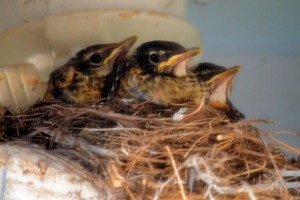
As the kids and I unloaded the van and were putting the food away together, my daughter called me to the backyard.  We’ve been tracking the progress of a Robin’s nest for a while now.  The babies finally hatched (featured in yesterday’s post) and they are growing more restless by the day.  Their routine has been: sit quietly for a while, then frantically call for their mom who comes swooping in with a huge worm clutched in her beak.  She hoovers in the air, wings rapidly flailing, while she gives each baby bird part of the worm.  Then, in an instant, she flies off in search for more.  She’s extremely shy, and no matter how many times I quietly race out there with my camera, she’s gone in a flash.

In the middle of unloading everything, my daughter called to me that Mamma is back again with yet another worm to settle their veracious appetites.  I got there just in time to see her in action.  She was so quick, I couldn’t even focus my lens before she vanished.  But, for a brief moment, I watched her do her thing.  It touched me in a special way.  I stood silently and watched those babies rustle their feathers and squirm about in the nest.  They won’t be there much longer.  One baby hopped up onto the side of the nest and peered over the edge several times out of curiosity.

It was then I made the connection to Mamma Robin.  She and I, oddly, live similar lives.  She built a strong nest to hatch her babies.  The walls are unusally high, and even on the top step of a ladder (yeah, I know, what was I thinking!) I still could not see into the nest.  Indeed, she built a humble home for her little ones up under the roof of the house to protect them from the hawks that are common here.  She sat with them while they were very young, and now spends most of her time and energy caring for their needs.

Oh how I can relate!  Ironically, her flying to and fro made me chuckle as I had done the exact same thing yesterday, except I drove from store-to-store.

All three birds comfy and cozy yesterday.

Baby Robin #1 left home yesterday afternoon…and landed right into our pool.  My daughter didn’t hesitate to jump in after it.

It’s so scared!  But it’ll be fine.  It’s in good hands (literally!)

Wet, but safe!  It shakes off the water, as well as the whole experience, and runs under a bush.

Yesterday, two were left.

We can tell #2 is getting ready to leave by the way it paces and hops around.

<<Baby Robin #2 left sometime last night or early this morning.>>  We were excited to see her hopping around this morning.

The elusive mamma captured in a rare (albeit fuzzy) photo.

Baby Robin #3 is the only one left this morning.

While writing this post this morning, my kids called to me to come quickly.  I arrived just in time to see #3.  After perching on the edge and pacing back and forth, he finally gathered the courage and took flight.

Oops!  Trying to learn to fly, he landed in the pool, just like Baby #1.  My daughter rescued him as well.  Here is is wet and flustered.

The empty nest.

My mom’s heartstrings pulled as I gazed at this quiet nest.  For many days it was a time of anticipation and excitement.  The eggs hatched, and three adorable babies entered the world.  They grew a little each day.  Mamma Robin faithfully attended their needs.  They began to wriggle around in the nest, jockeying for position to receive the most food.  They discovered there is an edge to the nest.  And beyond the edge, there is something mysterious – a ledge of sorts.  On that ledge, they are able to see down to the ground and out into the horizon.  They curiously looked around, rustling their feathers and boasting their chests.  Mamma bird called and they jumped back into the nest.  There she found them waiting for another meal.  She left to hunt again, and they hopped back out onto the ledge, each time with a little more boldness and courage than the time before.

Then it happened.  The first one flew away.  The second one flew away.  The third one flew away.  The nest is quiet.  Mamma’s job tending the nest is finished.  She follows them on the ground for a while, still bringing them food, but no longer do they fly back to the safety of the nest.  They are on their own.  This is, indeed, the story of our children.

What seemed like forever waiting for these baby chicks to grow into cute, fuzzy birds, is now a mere memory recorded in pictures.

In my family, I have one chick perched on the edge, one rustling her feathers, and one pretty comfortable snuggled in the nest.  I can provide.  I can watch over them.  I can tend the nest.  But, I cannot stop time and nature from taking its course.

A bird can only appreciate her job so much.  She is, after all, a bird.  But, we are made differently.  We are made in the image of God – with thoughts, feelings and responses.  We have the ability to embrace the task of mothering that God has given us and do it to the best of our abilities.  I never once heard Mamma Robin squawking and complaining to the other mammas about her job.  I never saw her make the babies feel guilty for having needs.  We can learn a lot from this mamma.  Do we take our jobs to heart and show our gratitude for the blessing of our children?  Do we enjoy the time we have with them or wish it would hurry up and end?

I once overheard a mother in a store talking to a friend.  The mother’s middle school daughter was standing right beside her when the mother said, with great enthusiasm, “Yes!  I just have a few more years and then I am FREE!  I won’t have any of this anymore and I will be FREE!”  Oh how my heart broke for that beautiful young lady who stood there with her shoulders down and face to the ground.  That was several years ago.  I wonder how that mom is enjoying her freedom now, because I can’t imagine the daughter ever wanting to revisit her nest.

It’s a cliche, but time is short.  Make the most of it.  Most mothers wanted their children when they had them.  Do we truly act like it?  These are harsh words, but it’s the raw reality that in a self-centered society such as ours, the kingdom of mothers can quickly turn into a whiny parade of women who can’t let life be about anyone but themselves.

Our children will grow up and fly with or without us.  We have the responsibility to provide for their needs.  But, we have also been given the privilege to enjoy the journey along the way.  I lost my mom when I was 16.  I know time is short.  None of us know how long we have on this earth.  But, you have today.  I encourage you to enjoy it.  Enjoy tending the nest.  Enjoy providing.  Enjoy protecting.  Enjoy your children – while they are still children. And be thankful.

Favorite Fifteen! 15 things I love about being a mom

*** This just in!  For all of you wonderful people who prayed for my mother-in-law’s surgery yesterday, she came through it well.  We don’t know any of the details, but if I start getting weak in the knees I’m going back to the Scriptures from yesterday’s post!  Thank you for your prayers, emails, posts, texts and phone calls.  We appreciate them!

Okay…15 things I love about being a mom-in no particular order 🙂

*  I can convince my kids to dance with me in the middle of dinner.

*  “Say yes to the dress” while snuggling with my daughter on the couch.

*  When my tween son looks at me, his eyes sparkle and gleam with love that only a son can give.

*  My kisses possess magical power to heal hurts and hearts.

*   My high-school son keeps the notes I slip into his school lunch.

*  I have been blessed with this motley crew of humans that God put together under one roof who accept me just as I am.

*  All of our family’s private jokes.  Priceless!

*  I have dozens of pet names for my kids.  They know them all and answer to them!

*  They trust me and know I’ve got their best interest at heart.

* Performing an animated solo flash-mob to my teenage daughter while the grocery store’s overhead speakers played Whitney Houston’s song, “I will always love  you” in the middle of the checkout line last night.  The clerk laughed as I walked out with my arm around my sweet thing serenading her all the way to the van.

*  We’re not afraid to talk about the tough stuff.

*  The smell of their freshly washed hair.

*  Watching them grow into amazing young adults.  What a privilege.

*  They give me an excuse to drop everything and have a pillow fight in the living room!

*  No one else but my family would want to live with me! 🙂


The Call

Psalm 34:6 – This poor man called, and the LORD heard him; he saved him out of all his troubles.

This month marks the two year anniversary of one of the most shocking experiences in my life.  It is the month we almost lost our son in a freak accident during school.

I’ll never forget it.  I was on my way home with my other two children when my cell phone rang.  Isn’t it odd how our instincts know when the call is bad?  Wary, I answered.  It was our son’s teacher.  He told me that there had been an accident during P.E. and our son needed stitches.

Okay, I’ll be right there, I replied.

I changed the direction of the van and immediately drove to school.  Upon arrival, I was startled to see his head wrapped in gauze because  I didn’t understand what had happened at that point – only that I needed to take him to the hospital.  I called my husband and got his voice mail.  We have a system of calling to identitfy an emergency, but up to that point we never had to use it.  This was not a false alarm.

He called me back and said, You used our emergency system, is everything okay?

No, I answered.  There’s been an accident.  Meet us at the hospital.

He abruptly ended his conference call, left work and met us at the hospital.  The doctor removed the school’s bandages, and we all got a first look at the injury.  My knees grew weak.

There was a very large, gaping hole in my son’s face.  We could see all the way up and deep into his tissue.  What in the world?

My son suffered an impalement, and it nearly cost him his life.  Any other trajectory of the object, and it could have easily resulted in a permanent  impairment or fatality.  He could have easily loss his sight, his hearing, his nose or his teeth.  Worse, it could have killed him.  Oh, when I think back to it my stomach turns.

Miraculously, after weeks of pain, the only visible reminder left is a large scar.  He was literally millimeters from death, and God spared his life.  He made a full recovery – all praise and glory to our Lord!

Times like these remind us of how precious life is, and how easy it is to lose it. We are also reminded that God has a plan, and even though we live in a fallen, sinful, hurting world, God is above all and He can make something good come from something bad.  For our son, he was very grateful for the show of care and concern by classmates he thought didn’t care at all about him.  He was humbled by the love shown by family and friends.  Our son saw firsthand the power of God and intervention in his life.  He has used his story many times to give witness to the saving power of God.  He allowed God to work in his life, and this incident made him stronger in his faith and in his daily life.

When bad things rock our world, we become stronger or weaker.  Bitter or forgiving.  Soft-spirited or hard-hearted.  It’s our choice.  For our family, we know and rest in the assurance that God sees all, knows all, and nothing can happen that has not passed through the hands of our Father. God doesn’t create bad.  He is the Author of good.  So many times in this world, God gets dubbed the bad guy. God is good.  God is holy.  God is loving.  He cannot be both bad and good at the same time.  However, He does allow bad things to happen – but not without a redemptive plan.  The Garden of Eden was the only perfect paradise on earth, and we simply don’t live in that world anymore.  However, God can radically work in our lives – for our good – if we let Him.

Do we understand why bad things happen?  No.  I don’t have answers, explanations, or justifications.  I only know that God can bring good out of bad and can spare us hard hearts if we allow ourselves to be pliable in His hands.

I don’t take this persepctive because we had a happy ending.  If you’ve read my other blogs, you’ve seen that there have been many times in my life that did not result in a happy ending this side of Heaven. This doesn’t mean I can’t find joy in my every day.  Sometimes what happens in life isn’t our choice.  But, how we respond is our choice.  I encourage you to seek God and ask Him to work in your life and show you the glory of His redemptive power.

If you are also thankful today for a near miss, a sparing of life, for a loved one or yourself, celebrate with me with the verses below.

Daniel 3:13 – Furious with rage, Nebuchadnezzar summoned Shadrach, Meshach and Abednego. So these men were brought before the king…16 Shadrach, Meshach and Abednego replied to the king, “O Nebuchadnezzar, we do not need to defend ourselves before you in this matter. 17 If we are thrown into the blazing furnace, the God we serve is able to save us from it, and he will rescue us from your hand, O king. 18But even if he does not, we want you to know, O king, that we will not serve your gods or worship the image of gold you have set up.”

The king’s command was so urgent and the furnace so hot that the flames of the fire killed the soldiers who took up Shadrach, Meshach and Abednego, 23and these three men, firmly tied, fell into the blazing furnace. 24 Then King Nebuchadnezzar leaped to his feet in amazement and asked his advisers, “Weren’t there three men that we tied up and threw into the fire?” They replied, “Certainly, O king.” 25 He said, “Look! I see four men walking around in the fire, unbound and unharmed, and the fourth looks like a son of the gods.” 26 Nebuchadnezzar then approached the opening of the blazing furnace and shouted, “Shadrach, Meshach and Abednego, servants of the Most High God, come out! Come here!” So Shadrach, Meshach and Abednego came out of the fire, 27 and the satraps, prefects, governors and royal advisers crowded around them. They saw that the fire had not harmed their bodies, nor was a hair of their heads singed; their robes were not scorched, and there was no smell of fire on them. 28 Then Nebuchadnezzar said, “Praise be to the God of Shadrach, Meshach and Abednego, who has sent his angel and rescued his servants! They trusted in him and defied the king’s command and were willing to give up their lives rather than serve or worship any god except their own God.

 Exodus 14:10-14, 26-29 – As Pharaoh approached, the Israelites looked up, and there were the Egyptians, marching after them. They were terrified and cried out to the LORD. 11 They said to Moses, “Was it because there were no graves in Egypt that you brought us to the desert to die? What have you done to us by bringing us out of Egypt? 12 Didn’t we say to you in Egypt, ‘Leave us alone; let us serve the Egyptians’? It would have been better for us to serve the Egyptians than to die in the desert!” 13 Moses answered the people, “Do not be afraid. Stand firm and you will see the deliverance the LORD will bring you today. The Egyptians you see today you will never see again. 14The LORD will fight for you; you need only to be still.” 26 Then the LORD said to Moses, “Stretch out your hand over the sea so that the waters may flow back over the Egyptians and their chariots and horsemen.” 27 Moses stretched out his hand over the sea, and at daybreak the sea went back to its place. The Egyptians were fleeing toward it, and the LORD swept them into the sea. 28 The water flowed back and covered the chariots and horsemen—the entire army of Pharaoh that had followed the Israelites into the sea. Not one of them survived.  29 But the Israelites went through the sea on dry ground, with a wall of water on their right and on their left.

Acts 16: 22-23, 26-30 – The crowd joined in the attack against Paul and Silas, and the magistrates ordered them to be stripped and beaten. 23 After they had been severely flogged, they were thrown into prison, and the jailer was commanded to guard them carefully.26 Suddenly there was such a violent earthquake that the foundations of the prison were shaken. At once all the prison doors flew open, and everybody’s chains came loose. 27 The jailer woke up, and when he saw the prison doors open, he drew his sword and was about to kill himself because he thought the prisoners had escaped. 28But Paul shouted, “Don’t harm yourself! We are all here!” 29 The jailer called for lights, rushed in and fell trembling before Paul and Silas. 30 He then brought them out and asked, “Sirs, what must I do to be saved?”

 Acts 28:1-5 (After the northeaster storm and shipwreck) – Once safely on shore, we found out that the island was called Malta. 2 The islanders showed us unusual kindness. They built a fire and welcomed us all because it was raining and cold. 3 Paul gathered a pile of brushwood and, as he put it on the fire, a viper, driven out by the heat, fastened itself on his hand. 4 When the islanders saw the snake hanging from his hand, they said to each other, “This man must be a murderer; for though he escaped from the sea, Justice has not allowed him to live.” 5 But Paul shook the snake off into the fire and suffered no ill effects.
Zephaniah 3:17 – The LORD your God is with you, he is mighty to save…
With a grateful heart,

Kristi

Untangle the web of lies – What a teenager won’t tell you

As I prepare to speak to teen girls about brutal lies and cultural myths that we get so easily caught up in, writing about some of them on this blog has really helped me organize my thoughts.  I hope it has been beneficial to your journey as well.  Revisiting memories has been understandably painful at times, but it’s also been a huge blessing to see just how far God will go to rescue someone; that everyone is valuable to Him; and sticking through the rough times reaps beautiful blessings on the other side.

Two cents.  That’s all I have in my pockets today.  I want to offer my two cents with some tips that may help smooth some rough spots with teenagers when life gets hard.  I am not a trained professional.  My opinions are based on my experience, what I’ve learned in college and as a volunteer.  What works for some may not work for others.  Always consult a qualified professional before making significant changes in a teen’s life who has suffered loss.

* When dealing with a teen who has a sick or dying parent, don’t take I’m fine as an answer.  Certainly don’t push the teen to talk, but understand that those two words have little to no value.  If you hear them, let it be a red flag that you may want to follow-up on.  Sometimes they may not be up to talking, but they can also be testing you to see if your inquiry to their well-being is genuine or if it is really just to ease your own conscious.  Don’t ask them how they are doing.  How do you think they are doing?  Instead, ask how they are holding up.

* Familiarize yourself with the 5 stages of grief: denial, anger, bargaining, depression, acceptance.  Website of grief stages and their explanations.

Understand that everyone grieves differently.  People should never compare grieving!  We are unique, as are our experiences and how we process them, and it is completely unfair to place our own expectations on someone else.  Judge not – it’s like kicking them when their down.

Understand that the first 12 months are extremely important in grieving.  This doesn’t mean we count the months beginning in January, it means 365 days from the day the parent died.  Think about it, there are so many things that happen in a year (holidays, school events, social events, big and small moments in life that surround a particular date or memory), a full cycle needs to be lived out in order to understand life is never going to be the way it used to be.  Quirky family traditions for April Fool’s Day may change, first-day-of-school dinner may not happen, you know, family stuff – it’s all different now.  Be patient with the teen as they try to live through a year of firsts so they can begin to find a new sense of normal.  Yes, a full year.  I believe productive grieving can take place during that year, but life needs a year just to walk through each of the 365 days of being and feeling different.

The Hospice website is an excellent resource for the whole family.  They offer priceless words of wisdom for teens, as well as a host of other resources for children, parents and caregivers.  I highly recommend this site for caregivers, family and close friends.

* Listen.  Listen.  Listen.  Don’t be so quick to offer a resolution, solution, or fix.  Just listen to them.  It’s amazing what can surface when a teen actually gets to have our undivided attention.

* For trusted friends and family – be there.  You don’t have to say anything, just offer a presence.  Teens who have suffered significant loss are waiting for everyone else to leave, too.  Find something the teen likes to do and offer your time with permission (i.e., watch sports, walk the dog, go to the movies).

* You can’t replace the loved one they’ve lost, but you can help ease the pain.  Remember back-to-school shopping I wrote about?  Perhaps offer to fill in a gap when the teen doesn’t know how to ask for help.

* Make your home a safe place.  Teens go through a lot every day – even on the best day hormones are raging and emotions can be unpredictable.  In a safe environment (not just physical, but emotionally safe meaning they feel free to be themselves without judgement) the teen can drop their guard and may just open their heart.

* Say the name of, and talk about, the parent who died.  One of the most painful aspects of grieving is that the loved one becomes invisible – as if he or she never existed.  People are either too uncomfortable or too worried they’ll upset the teen if they mention the parent, therefore nothing gets said.  For me, it was literally years before anyone ever said my mom’s name (my own family never even mentioned her).  It was an old friend of my mom’s who approached me.  She didn’t know that my mom had died.  This friend asked how she was doing.  I told her, and the friend immediately began apologizing up and down.  I interrupted her and said, Thank you.  You’re the first person to say her name to me in years.  It’s feels good to hear others remember her.  It was about 5 years after my mom died when I realized I had forgotten what her voice sounded like.  It absolutely devastated me!  I cried and cried.  Their legacy, memories and media (photos, video) are really all we have left.  Give the teen the chance to relive good memories when they’re ready.  It can be very healing.

* Offer to help.  There may be large needs you may or may not be able to help with, but I can promise you there are a myriad of small needs beloved friends and family can help meet.  If the teen is in sports, drama, music or any performance activity, offer to attend.  Empty seats are a heart-breaker.  Remember the teen’s birthday with a card or phone call.  Remember the deceased parent’s birthday with a card or phone call.  Offer to help rake the leaves in the fall, plant flowers in the spring, or go for ice cream on a Saturday afternoon.  Just being there is so helpful.  Offering a hand and sharing a smile in the everyday moments of life make the big milestones (holidays, anniversaries, birthdays, etc.) more bearable.  If everyone close to the teen each did one thing, just think about what a difference that would make to remind them they are valuable, loved, and remembered.

Consider letting the teen make some decisions about their life when appropriate.  One of the best gifts my grandparents ever gave me was the freedom to let me choose whether or not to attend my high school graduation.  I DID NOT want to attend for various valid reasons.  They didn’t push the issue with me.  Today, I still don’t regret it.  Situations are different for everyone, but if a teen feels adamant about something that isn’t earth-shattering or life-changing, at least be patient and listen to their side. Teens in grief may appreciate feeling a little bit of control over their life in times of unrest.  My decision came almost a year after my mom’s death.  Careful consideration should be made concerning the 5 stages of grief and the teen.

* If you have pictures of the parent, scan copies and compose a small photo book for the teen.  Maybe add some short text about a funny story or memory; or what was special about the parent or how they positively impacted your life. People have different roles in each other’s lives. I can only imagine how wonderful it would be to have photos of my mom at work, out with girlfriends, etc. in roles other than as I knew her – Mom.  Online printing companies and superstores print these photo books for little cost nowadays.  It may take a few hours of your life to do this, but it will give the teen a lifelong treasure.  Wait for the appropriate time to give this gift to the teen.

* If I haven’t stressed this point enough already, make yourself available.  It may take days, weeks or months for a teen to be ready to talk, share or do stuff together, but just knowing you are willing to invest in their life can help talk a teen down from their proverbial ledge.  In the meantime, keep a watchful eye on symptoms that need to be addressed by a professional.  Offer a shoulder to lean on, an ear to listen, a heart to feel and hands to help, but know when to encourage the teen to seek professional help.  They are trained in the most appropriate ways to assist the teen to work through their grieving.  Our best attempt at “counseling” may prove to hurt the situation more than it would help.

********************************

I hope these suggestions have helped shed some light on an issue too dimly lit.  Teens are far too often swept under the rug because adults don’t give teens enough credit that they have thoughts, opinions, feelings, questions, and words that need to purged.  Most teens are profoundly affected by parent loss.  Literally, the teen’s future hangs in the balance of how healthy the grieving process has been.  Research is downright scary for teens who are unheard, ignored, and not helped through every stage of grieving.  It could be the beginning of a downward spiral, or, with proper attention and care, the teen can come through the entire experience with hope, optimism, healing and strength.

Give the teen in your life every opportunity to grieve, mourn, heal and realize their full potential.  They have the rest of their lives ahead of them.  May they experience the abundant life Jesus calls them to in John 10:10 – The thief comes only to steal and kill and destroy; I have come that they may have life, and have it to the full.


Untangle the web of lies – fathers & daughters

I have been given the humble privilege of speaking to high school girls about lies young women believe.  With this task, I must go to the locked parts of my heart and open the door to my past – which is complicated.  Why bother? I’m on the other side now!  I’m married with children, wounds are healed, and life has moved on.

However, there are scores of young women in the generation behind me that are sinking in quicksand of brutal lies and cultural myths.  I have been there and deeply know their pain.  So, with my proverbial flashlight, muck shoes and a rusty set of keys, I’m going to dig beneath the surface of my current life and venture to lessons learned from my past, in hopes of speaking Truth into young women’s futures.

There are numerous books and articles written by professionals on this subject.  I simply want to tell my story.  An average, American girl and the positive and negative effects social culture and family dynamics have on a girl’s self-esteem, confidence, and perceived value.  I’d like to utilize this venue to think through a few things before speaking to the girls.  There will be more than one blog as we tackle different facets of the tumultuous middle and high school years.

(Deep breath) Here we go…

My mom’s second marriage began when I was four years old.  Her first marriage ended when I was one, and my birth father gave me up for adoption.  As a result, my stepfather adopted me.  It’s strange. Even at four, I knew I was merely baggage being brought into their 7-year marriage.  I felt left out, unwanted, and more of a burden to my stepfather than anything else.  My remedy?  Fly under the radar from day one.  Be as good of a girl as I could be, and although he might never like me, at least there will be peace in the house.  I may not have known those kinds of colloquiums per say, but I certainly understood the feelings associated with them throughout my childhood.

There is a ton of research today on the effects fathers have on daughters.  About a year ago, I was driving alone in my van when I heard the radio the program “Focus on the Family.” A psychologist was talking about what happens when a daughter (or stepdaughter) doesn’t receive affirmation and validation from her father (or stepfather) in her formative years.  There I was, just driving along, minding my own business.  As I listened to the discussion, I burst into tears and nearly threw up on the steering wheel – my reaction was instantaneous and reflexive.  Wow.  I didn’t see that coming.  A flood of emotions overtook me, and there was nothing I could do to stop it.  Every single point the psychologist made was spot on.

A woman can hear every day from others how beautiful she is, but if she never heard it from her father – there is a chasm inside her psyche that remains void.

To this day, I have never heard from my birth father, stepfather or grandfather (all now deceased) one single word that I was pretty, much less beautiful.  If they thought it, they never said it, and I wasn’t given any reason to believe this was the case.  I cannot tell you how much damage this did to my self-confidence and feelings of worthlessness.

When I draw my last breath, I will have lived my entire life without ever having heard those words from the influential men in my life.

This sent me spiraling as an adolescent and teenager to try to convince others I was beautiful so I could hear those words from them.  I just needed to hear it from someone.  That’s my point.  If a father (or male influence) doesn’t tell the daughter in his life she is beautiful (both inside & out), she will look for that affirmation elsewhere to fill this innate need in her development.  It almost feels like a rite of passage into womanhood, and when it doesn’t happen, the girl never truly feels like she gets to grow into a woman.  Rather, she is stuck in a twilight zone of being and looking like a woman, but still seeing her reflection in the mirror as an awkward adolescent.

I remember one time in high school, my friends (a guy and a girl) and I were going out for the evening.  I rode in the passenger seat while he drove.  My other friend rode in the backseat.  When we reached our destination, I pulled the sun visor down to look at myself in the mirror.  I frantically checked everything in the minutest detail – hair, jewelry, make up, clothes, my smile – everything.  He turned to me and sarcastically said, So…are you going to date that mirror?  Ug.  His lack of tact, inferring I was staring too long at myself, was more salt rubbed in the wound of a girl who was desperate to hear that she was pretty so she didn’t need to scrutinize herself in the mirror of some guy’s car.  To hide my embarrassment, I laughed (with him, I might add) and quickly flipped up the mirror and bolted out of the car.

Fathers (or male authority figures) wield much influence over daughters.  This can be done the right way or the wrong way.  God forbid the father make fun of or be rudely critical of his daughter.  If so, he has set her up to be a candidate of marrying someone that will do the same to her, and the girl – now woman – will find it nearly impossible to realize her full sense of beauty if she’s always told she is the opposite.

Some dads may not be harmful with their words, but may be mute (as such was my case).  This defaults to the girl that she, indeed, is not beautiful.  Girls are hard enough on ourselves in the middle and high school years.  If we are not hearing the opposite of what we are already telling ourselves (I’m fat.  I’m ugly.  I’m a loser.  I’ll never measure up.), then the silence from father figures will validate these lies.

But, if a father pours words of affirmation into his daughter, she is validated from an early age.  This, in turn, boosts her self-confidence to follow her dreams, take healthy chances in life, and be beautifully independent from needing unhealthy approval. She can approach the world without having to date a mirror to feel accepted.  Yes.  A father’s influence is that powerful.

Fathers need to own their responsibility with their daughters.  They need to make time as often as possible to tell their daughter she is beautiful inside and out.  Even if things aren’t perfect between you two (life seldom is), but the relationship is open to communication, find something beautiful about your daughter and say it to her.  Preferably face-to-face, but if that’s not possible, text, email, voicemail, Facebook, IM, Skype, Oovoo, written mail, hire a plane to write it in the sky, or however it can be done – just do it.  You have the opportunity now to set her up for success for the rest of her life.  Take it.  As I have found out, life is short and you may miss your chance.

<<Check out the companion song to this blog on my Tunes page and book recommendation on my Books page!>>

******************************************************************************************************************************

(A note to parents: Sons need to be reared from the beginning to be kind, in word and actions, toward their mothers and sisters.  When a boy has grown up finding the good in their mom and sisters, it will be more natural for him to find it in his wife and daughters.  Start now teaching sons what true beauty is, and to not miss an opportunity to tell her so.  This is one thing I love about my boys.  They are tween and teen and tell me on a regular basis how beautiful I am.  They notice my haircuts or maybe a rare, new outfit, but more often they tell me how much they like my jokes, admire how hard I work, and that I have, according to my youngest, the “bluebirdiest singing voice.”  They are learning to dig beneath the superficial surface of physical appearance and uncover the priceless hidden treasure of inner beauty.  How do they know this?  They see their dad example it.  And, I’m quick to tell them how much it means to me.  It’s never too early or late to start.)

True Beauty

Recently, my teenage daughter and I began reading 5 Conversations You Must Have with Your Daughter by Vicki Courtney.  We were instantly hooked on this book!  It pulls no punches when discussing true beauty and self-worth compared to the false standard society wants us to believe.

The first section title reads, “You are more than the sum of your parts.”  Yes! Beautiful truth poured from this book into my daughter’s heart (and mine, too). Refreshing.  Empowering.  However, less than 24 hours later, I stood speechless in the checkout line at the grocery store as one magazine cover caught my eye.  It is a popular, mainstream magazine with its place marker square in the middle of the stand for all to see.  What I saw on it, I wished I hadn’t.  There was a woman, fully naked, donning the cover.  Even part of the article title said so-and-so bares all.  There was no ambiguity here…they absolutely put a fully naked woman on a magazine that will sit on mainstream stands across America, and who will see those magazine covers?  You, me, and our children.

I was still digesting the powerful statements and facts 5 Conversations gave us the night before regarding the value of inner beauty and the ugly lies disguised in the latest fashion trend, when there I stood face-to-face with the antithesis of the book.  A fury ignited in me.  How dare people subject my sons to this!  We prohibit movies, video games and books that have this kind of imagery in them, and all my tween and teen boys have to do is wait with me to buy milk and are subjected to an image they ought not to see.  I was angry that my sons, who work deliberately and diligently at being gentlemen, would see this. Then another horrifying thought occurred to me.  What if my daughter had been here?  How do I justify this magazine after reading 5 Conversations last night?  Of course she knows I wouldn’t outwardly rationalize and justify the nude, seemingly perfect body and everything it represents, but if I say nothing then I am sending the same message of approval.

After checking out, I asked to speak to the manager.  I told him how disappointed I was that a grocery store that advertises itself as family friendly would put this front and center of the checkout line at young children’s eye level.  I pointed to the article sidebar, …and make no mistake, she’s naked.  The title even says it. He replied that he has seven children and understands my concern, but has no control over it.  I agree that he has no control of what they put on magazines, but as the manager, he does have control of what he does with that magazine in his store.  I offered three suggestions: remove this issue; move it to the back of the store where the other questionable magazines are; or, if by contract it needs to stay at the checkout line, then it should have a cover in front of it.  He offered to remove this issue from the racks altogether.

The next day, I’m back in the store for a forgotten item, and to my surprise, there was the magazine back on the racks of the checkout aisles.  I asked to speak to the manager again.  He explained that the ones he removed were still sitting on his desk and that someone else must have restocked more copies.  I reminded him of his seven children, and my children, and all children, and said, For this magazine, perhaps you should check on it more frequently until a new issue comes out.  He said he would remove the new ones and ask the clerks to keep an eye out for future similar problems.  To my delight, my third trip to the store several days later revealed not a single issue of that magazine on public display.

Was I an annoying, high-maintenance customer?  Probably.  Am I sorry?  No. My children aren’t the only ones subjected to these magazines staring back at us in checkout lines.  As a parent, I will remain vigilant to protect my kids from needlessly stolen moments of childhood.  For my sons, it is so they will not be tempted and become desensitized to what should be held sacred.  For my daughter, it is to reiterate that she is indeed more than the sum of her parts.  If we don’t tell our own daughters this, who will?

It is our responsibility to speak up and prohibit society’s unattainable, mirage-like status from becoming status quo in our homes.  Lives are at stake.  Health is at risk.  Self image becomes a slippery slope with enormous repercussions if not cultivated in the Truth that we are fearfully and wonderfully made (Psalm 139:14).   After all, if someone had taken the time to tell the woman who posed for the magazine that she, too, is worth more than the sum of her parts – she is a wonderful work of God – then perhaps she never would have sold her body for a fleeting photo in the first place.